
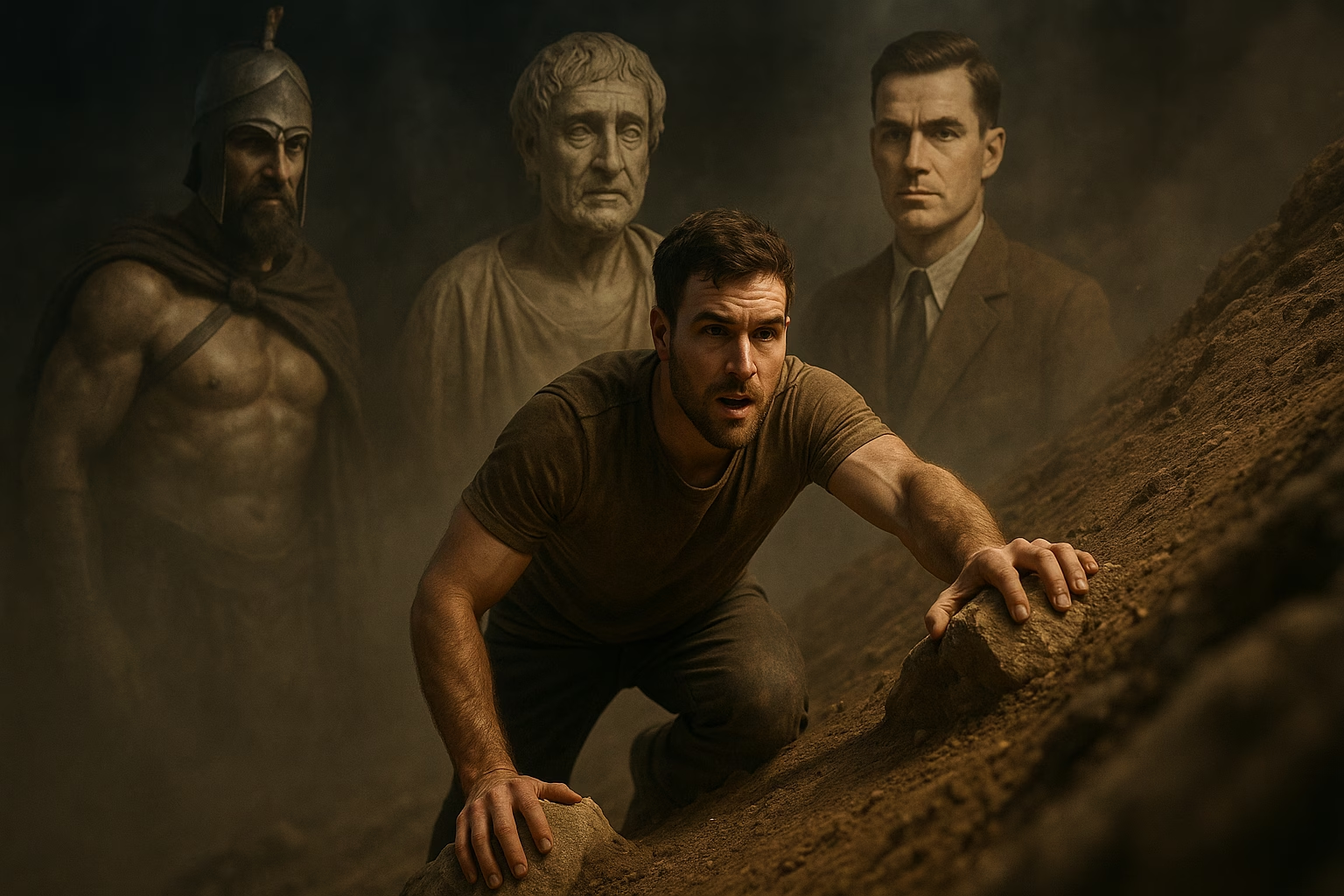
Every warrior knows that comfort never forged a fighter. The obstacle is not the end of the path — the obstacle is the path.
Every warrior knows that comfort never forged a fighter. Iron is sharpened on stone, and the human soul is refined in the crucible of hardship. At Honor Bound FIT, we don't run from obstacles — we run toward them. Because the obstacle is not the end of the path. The obstacle is the path.
Few men have lived this truth as powerfully as Admiral James Stockdale. Shot down over North Vietnam in 1965, he spent nearly eight years as a prisoner of war in the infamous "Hanoi Hilton." There, he endured torture, starvation, and years of solitary confinement. His body was broken, but his spirit never surrendered. Stockdale anchored himself in Stoic philosophy, especially the teachings of Epictetus and Seneca. Out of his endurance came what we now call the Stockdale Paradox — the discipline of holding two hard truths in tension: first, you must face the brutal facts of your present reality; second, you must never lose faith that you will prevail in the end. Many of his fellow prisoners clung to false optimism, telling themselves "We'll be out by Christmas." When Christmas came and went, they broke. Stockdale refused such illusions. That paradox was the lifeline that carried him and others through hell itself.
Centuries before Stockdale, the Roman Stoic philosopher Seneca wrote words that cut just as sharply today: "Difficulties strengthen the mind, as labor does the body." He taught that prosperity breeds softness, while adversity sharpens character. Without suffering, there can be no courage, no perseverance, no wisdom. Every hardship is a forge, every trial a whetstone. To reject suffering is to reject growth. To embrace it is to discover the depth of your own resilience. At Honor Bound FIT, we take Seneca's wisdom into the gym and into life: the barbell that won't budge, the run that makes your lungs burn, the ruck that feels endless — all of it is the training ground for something greater than muscle. It is the training ground of the soul.
The Stoics spoke of it. Admiral Stockdale embodied it. And today, warriors like Jocko Willink and David Goggins put it into words that ignite a fire in the modern age. For Jocko, the mantra is simple: "Good." Bad situation? Good — it's a chance to adapt. Failed lift? Good — you've identified your weakness. Setback in life? Good — you now have an opportunity to grow. His disciplined frame strips away excuses and reveals the truth: obstacles are opportunities. If Jocko gives us the disciplined lens, David Goggins gives us the relentless edge. Goggins sees suffering not as a burden but as the ultimate teacher. Together, these voices echo the same ancient truth: growth is not found in comfort. It is found in suffering.
Modern life has made it all too easy to avoid struggle. We drive instead of walk, eat instead of fast, scroll instead of sit in silence. In his book The Comfort Crisis, Michael Easter argues that this abundance of ease is quietly making us weak, sick, and restless. By insulating ourselves from discomfort, we've also insulated ourselves from growth. Easter suggests that humans are designed to push against challenge — to ruck long distances, to endure the elements, to wrestle with hunger and fatigue. His thesis echoes what the Stoics, warriors, and faith traditions have long said: comfort never made anyone strong.
One of the greatest disservices a parent can do to a child is to clear every stone from their path. With good intentions, mothers and fathers often rush to shield their sons and daughters from hardship, disappointment, or struggle. But in sparing them suffering, they also spare them growth. A child who never faces failure, never hears the sting of "no," or never learns the weight of responsibility, enters adulthood untested, untempered, and unprepared. As Seneca would remind us, difficulties are the very tools by which character is forged. To raise resilient men and women, we must allow them to encounter obstacles, to struggle against them, and to rise stronger on the other side.
Even beyond philosophy and the warrior's ethos, the Christian tradition recognizes the refining fire of suffering. C.S. Lewis once wrote that "pain is God's megaphone to rouse a deaf world." The Apostle Paul said it this way: "Suffering produces endurance, endurance produces character, and character produces hope." (Romans 5:3-4). What the Stoics knew by reason, Paul confirmed by revelation: suffering is not the end. It is the pathway to transformation. The obstacle is not your enemy. It's your teacher, your forge, your proving ground. The obstacle is the way. Growth is found in suffering. And that is why we train.